Self-interlocking composite layers
Composite veneers are typically built in layers such as dentin, body, and enamel shades. In conventional techniques, these layers rely mainly on chemical bonding between them. Such chemical bonds perform adequately under slow laboratory testing conditions where flexural strength is typically measured. However, veneers in the oral environment are exposed to rapid loading and may become highly susceptible to brittle fracture under elevated material strain rates, because the effectiveness of micromechanical interfacial bonding can be severely limited under fast loading conditions.
Composite layers may contain invisible nanoporosity as well as visible pores that can appear clinically as haze. As a result, the composite veneer structure may lack adequate bending stiffness, partly due to high shear compliance between the individual composite layers.
The NETFIL Mesh Tool introduces macro-mechanical keys between the composite layers that are far less sensitive to strain-rate limitations. These interlocking features help distribute stresses more uniformly and fundamentally reduce the interlayer shear compliance when loads occur rapidly. Instead of concentrating stresses at localized points, forces are shared across mechanically engaged layers, thereby improving the damage tolerance of the veneer under high-strain-rate conditions. The objective of our Netfil Mesh approach is to enhance the ability of the veneer structure to withstand bending and shear stresses when loading occurs rapidly or unexpectedly during clinical function.
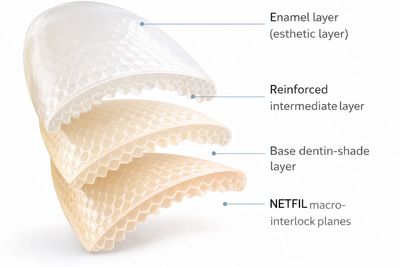
A Note On Dental Composite Veneer Longevity
Longevity Is Not About Peak Strength — It’s About Strain-Rate Tolerance
Dental restorations rarely fail because their peak strength is too low. Rather, they fail because they cannot adequately withstand rapid and cyclic forces present in the oral environment.
Natural teeth, composed of enamel and dentin, are not necessarily the strongest materials in absolute terms, yet they survive for decades because they tolerate high strain-rate loading remarkably well. Tooth enamel and dentin minimize shear compliance through their highly organized hierarchical morphology. This internal architecture allows stresses to be redistributed efficiently before cracks can propagate.
Conventional composite materials may exhibit high strength under slow laboratory loading conditions, yet they often struggle under rapid intraoral forces. Although these materials may possess high modulus and significant peak load-bearing capacity, high interlayer shear compliance and inadequate bending stiffness can overshadow these otherwise favorable material properties.
By introducing engineered mesh structures and macro-mechanical interlocking, stresses can be redistributed more efficiently during rapid loading events. This structural approach promotes crack deflection, reduces localized stress concentration, and enhances the overall resilience of the composite veneer.
Clinical longevity therefore depends less on maximum strength and more on how effectively a material performs under real-world dynamic loading conditions. In this context, dentists and dental laboratory technicians can readily evaluate the Netfil Mesh approach and appreciate how controlled macro-mechanical interlocking can significantly improve the structural robustness of layered composite restorations when applied meticulously.