The NETFIL ®Advantage: Rethinking Resin Post-Processing

The consequence of 3D resin wash and cure
Rethinking Post-Processing: Why IPA Washing Matters ( In brief)
Post-processing is not always harmless to a 3D-printed resin composite. IPA washing can interact with the partially cured resin, causing swelling and extracting unreacted monomers. This may leave microscopic defects on or beneath the surface after final curing.
These tiny defects can make an existing sharp V-notch more vulnerable to fracture, even when they are individually much smaller than the critical flaw size.
The resin also continues to change after curing. During the first 24 hours and beyond, physical aging and residual-stress redistribution can alter its mechanical behaviour and notch sensitivity.
This is why post-processing and conditioning time matter. Our observations show that IPA washing and insufficiently developed NETFIL GLIMMER® macrotexture can substantially affect fracture resistance.
The takeaway: A successful 3D print is not just about printing and curing. How the part is washed, finished and conditioned can make a significant difference to how well it resists fracture.
Rethinking Post-Processing: Why IPA Washing Matters ( In detail)
Post-processing is often treated as a routine resin cleaning and curing operation in resin-based 3D printing. However, the interaction between a cleaning solvent and a partially cured polymer extends beyond the removal of residual surface resin. NETFIL's ground breaking research most certainly draws attention to a potentially important consequence of isopropyl alcohol (IPA) washing. Powerful solvents such as IPA, change the surface and subsurface of a printed component altering its fracture toughness. This potentially unfavorable consequence of IPA washing can be very easily and clearly demonstrated using sharp V-notched specimens, where a sharp discontinuity concentrates stress and creates a preferred site for easy crack initiation.
Our NETFIL GLIMMER ® macrotexture magnifies the effect of IPA washing on notch sensitivity, making the resulting changes in fracture behaviour distinctly observable during V-notch testing. This enhanced sensitivity allows an easy and a direct comparison between IPA-washed and non-IPA-washed specimens, clearly demonstrating the influence of post-processing on the fracture resistance of 3D-printed resin composites.
What happens when IPA contacts polymer network which is not fully polymerized ?
High-concentration IPA can penetrate partially cured polymer networks through solvent sorption and diffusion. The extent and rate of penetration depend on the resin chemistry, degree of conversion, crosslink density and exposure conditions. Once inside the network, IPA may interact with the polymer segments and promote solvent uptake and swelling. At the same time, it can dissolve compatible residual monomers, oligomers and other mobile components, allowing some of these species to migrate out of the material and into the surrounding solvent. Once inside the network, IPA may interact with the polymer segments and promote solvent uptake and swelling. At the same time, it can dissolve compatible residual monomers, oligomers and other mobile components, allowing some of these species to migrate out of the material and into the surrounding solvent.
These are the distinct processes:
- Solvent uptake: IPA enters the polymer network.
- Swelling: The absorbed solvent expands the network.
- Extraction: Soluble mobile components leave the polymer.
- Drying: IPA evaporates, and the network may contract without recovering all its original composition or structure.
- Curing: Curing takes place without the monomer or species that has left the polymer
Even a brief IPA washing cycle can alter a mechanically critical region such as a V-notch tip even when the specimen appears to be macroscopically intact.
A V-notch creates severe local stress concentration. Under bending, the highest stresses develop in the region surrounding the sharp V- notch tip, making the local material condition particularly vulnerable.
If IPA exposure alters that region through swelling, extraction or associated microstructural damage, the V-notch becomes highly susceptible or sensitive to fracture initiation, irrespective of whether our Netfil Glimmer ® fracture toughening texture is present in and around the sharp V-notch.
Combining Intrinsic and Extrinsic Composite Fracture Toughening Mechanisms Using Netfil ® GLIMMER
Fracture-toughening mechanisms are broadly classified as intrinsic or extrinsic, depending on how they influence the advancing crack front. Intrinsic mechanisms operate primarily within or ahead of the crack-tip process zone, influencing resistance to crack initiation and extension. Extrinsic mechanisms operate predominantly in the crack wake, shielding the crack tip through mechanisms such as crack bridging, crack closure and frictional resistance.
Unlike architectures that introduce reinforcement only within selected regions of a composite, NETFIL Glimmer ® employs a distributed macrotextured architecture extending throughout the printed layers, including the external tensile surfaces.
This continuous architectural presence is particularly significant because its contribution to fracture resistance is not restricted to an advancing crack or its wake. Our NETFIL Glimmer ® macrotexture can potentially influence the local stress distribution and resistance to crack initiation at the tensile surface, as well as the mechanical conditions of deeper locations of material surrounding an advancing crack front. These contributions can be associated with intrinsic fracture toughening.
As the crack advances, the same macrotextured architecture can additionally contribute to extrinsic toughening through mechanical interlocking, crack deflection, bridging and energy dissipation within the crack wake.
Consequently, our NETFIL GLIMMER ® macrotexture need not be categorized exclusively as an extrinsic fracture-toughening mechanism. Its distributed architecture offers the potential to contribute to both intrinsic and extrinsic fracture resistance, addressing crack initiation as well as subsequent crack propagation.
Our NETFIL ® PROCESS complements this architecture by improving the integrity of the polymer network itself, with the objective of reducing free-volume defects and improving intrinsic material-level fracture toughness.
Together, our NETFIL PROCESS and NETFIL Glimmer ® offer a complementary approach to improving fracture resistance at both the polymer-network and architectural levels.
Our experimental testing and observations have now clearly indicated that our Netfil ® strategies can substantially reduce the notch sensitivity of sharp V-notches, particularly when damaging solvent-washing procedures such as IPA washing are avoided.
The Influence of Physical Aging and Post-Cure Stress Relaxation on Notch Sensitivity
It is well known that the mechanical response of a photopolymer may continue to evolve long after curing or hardening. Depending on the resin formulation and environmental conditions, residual reactive groups may undergo further polymerization, while unreacted monomers and other mobile constituents may migrate or escape from the composite surface.
The polymer network also undergoes physical aging as a gradual process, which can reduce the intrinsic fracture toughness of the composite resin matrix. Physical aging generally involves a reduction in the excess free volume within the resin matrix. However, this reduction may not occur uniformly throughout the material.
Spatially non-uniform free-volume reduction can result in variations in local density, molecular mobility and elastic modulus. These variations can alter the distribution of mechanical properties such as modulus within the resin matrix, potentially producing local stress concentrations under applied loading and increasing the brittleness of the aged composite resin matrix.
In addition, polymer networks undergo post-cure stress relaxation, during which accumulated internal stresses may not be relieved uniformly throughout the composite. This non-uniform relaxation can redistribute residual stresses, potentially producing local stress concentrations in and around the vicinity of a sharp V-notch.
Consequently, a sharp V-notch present in a testing coupon may exhibit increased notch sensitivity only after a 24-hour post-cure conditioning period. The evolving physical structure, local modulus distribution and residual stress state of the composite may collectively influence its fracture response during this period.
In this context, our Netfil Glimmer Film ® macrotexture decreases V-notch sensitivity by fundamentally serving to distribute stresses uniformly within composite, while also contributing to crack deflecting and energy dissipating mechanisms within the very same composite irrespective of the post-cure stress relaxation time .
In order to obtain the maximum composite reinforcement benefit from our Glimmer Film ® architecture, the following conditions have to be satisfied:
Our stress distributing / fracture resisting macromechanical keys on our Glimmer film ® should not be distorted or uneven. (This is because distorted and uneven features always tend to concentrate or pile-up stresses instead of distributing them.).
Our macromechanical keys on our Glimmer film ® need to have an optimal size or scale, and should not be random or irregular or too faint. ( Faint macro keys don't provide sufficient grip between the 3D printed layers, leading to poor reduction of interlayer shear compliance, negligible crack initiation prevention potential, negligible crack deflection and energy dissipation potential.).
Our macromechanical keying features on our Glimmer film ® don't fall below a certain threshold scale or size. (This is because our macro keys must be large enough to influence load transfer and deformation, without crowding out or over-populating the laminate surface and causing stress pile-ups .).
And last but not the least, it's crucial that the benefit of our Glimmer ® film's crack deflecting and energy dissipating architecture is not nullified by the formation of a tacky O2 depleted layer or IPA solvent damage during post-processing.
The Influence of IPA Washing on Notch Sensitivity and Fracture Behavior
When our sharp V-notch testing specimens are not washed with IPA, and sufficient care is taken to prevent surface tack, the major defect in the test coupon is the sharp V-notch itself. This is a relatively large, macroscopic and precisely positioned geometrical discontinuity.
When subjected to bending loads, crack initiation is substantially delayed by our NETFIL GLIMMER® macro-mechanical toughening architecture, whose macrokeys provide effective mechanical engagement between the printed layers. This makes the specimens considerably more resistant to fracture.
However, when the specimens are washed with IPA before final curing, the solvent can readily interact with the delicate, partially cured resin network. Solvent sorption, swelling and the extraction of unreacted monomers and other mobile constituents can alter the partially cured resin surface. Following final curing, this may leave an inferior surface or subsurface structure, increasing the sensitivity and vulnerability of the V-notch tip to fracture.
IPA-induced microscopic flaws near a sharp V-notch can intensify the local stress field and increase the likelihood of premature crack initiation. Furthermore, the surface and subsurface regions are where the advancing crack first encounters our NETFIL GLIMMER® macro-mechanical architecture. Damage in these regions may compromise its ability to provide effective crack deflection and associated energy dissipation.
A material with limited tolerance to defects, such as a 3D-printed resin composite, may therefore undergo premature and potentially catastrophic fracture when these microscopic flaws interact with the stress field surrounding the V-notch.
Critical flaw threshold describes the limiting defect condition at which the combined effects of applied tensile stress, defect geometry and the local mechanical properties of the composite become sufficient to initiate unstable fracture.
IPA washing can introduce microscopic surface and subsurface defects into the resin composite. Although these defects may be considerably smaller than the critical flaw size when considered individually, their presence in the vicinity of an existing sharp V-notch can increase the effective severity of the notch region and significantly increase susceptibility to premature crack initiation.
Consequently, defects that may otherwise be tolerable can contribute to unstable fracture when combined with the stress concentration and locally altered mechanical properties surrounding the V-notch.
- IPA induced surface flaws can act as additional stress-concentrating sites around the existing notch.
- IPA induced surface damage can compromise local polymer network integrity, allowing cracks to initiate at substantially lower applied tensile loads.
- Once the local fracture condition is reached, crack propagation can become unstable and accelerate rapidly.
Under these conditions, a crack may easily initate on the surface of composite and overcome the resistance offered by the NETFIL GLIMMER® macrotextured architecture, depending on the crack-driving force and the effectiveness of its reinforcing mechanisms.
NETFIL GLIMMER® macrotexture is designed to improve mechanical interlocking and modify interlayer stress transfer throughout the printed architecture, potentially enhancing resistance to both surface crack initiation and subsequent crack propagation.
The Big Takeaway
Our simple V-notch experiment proves that the benefit or success of any extrinsic hierarchical structure or intrinsic toughening is entirely governed by the surface and sub-surface flaw size. Washing 3D-printed components extensively using solvents such as isopropanol, removes the benefit of both intrinsic and extrinsic toughening mechanisms or features. It would be highly preferable to totally avoid IPA washing or find the minimal effective concentration of IPA for the washing procedure. Water washable 3D- printed resins and resin composites on the other hand, don't experience the damaging or fracture toughness reducing effect of Isopropanol.
Oxygen-Inhibited Layer's Relation To Fracture Toughness
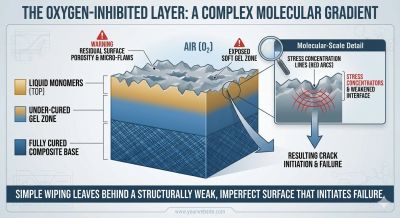
While manufacturing 3D resin composite components using 3D printing, achieving peak fracture toughness is always the ultimate goal. However it's well known that the surface tack, molecularly known as the Oxygen-Inhibited Layer (OIL) reduces fracture toughness of the component. It's well known that surface flaws and defects are not highly tolerant to tensile stresses acting in a composite.
At first glance, it's tempting to view this sticky residue as a minor surface nuisance that can simply be wiped away. But at the molecular scale, failing to properly manage this layer introduces severe structural vulnerabilities that can compromise an entire 3D printed component.
The Molecular Reality: OIL is a Gradient, Not a Line
A common misconception is that the oxygen-inhibited zone terminates at a perfectly flat, distinct boundary. In reality, it forms a dynamic chemical gradient. As ambient oxygen diffuses downward into the resin, it scavenges free radicals and disrupts the curing process. This creates three distinct zones on the uncured material:
- The Liquid Top: High oxygen exposure leaves a true, unpolymerized liquid.
- The Transition Gel: A fraction of a micron deeper, dropping oxygen levels result in a semi-cured, loosely cross-linked polymer gel.
- The Solid Base: Deep enough to escape oxygen diffusion, the composite achieves a fully cross-linked, high-density matrix.
Because of this uneven transition zone, simply wiping or washing the surface with a solvent like isopropyl alcohol (IPA) is not enough. Solvents strip the liquid top but expose the soft, uneven transition gel beneath it—leaving behind a structurally weak, microscopically riddled profile.
The Impact of OIL on Resin Composite Fracture Toughness
- Micro-Flaws Form Early: Under cyclic mechanical loading, a microscopically riddled profile or surface can easily become fracture initiation sites.
- Stress Concentrations Explode: The microscopic surface pits and notches may act as intense stress concentrators.
- Premature Failure Triggers: These micro-flaws allow cracks to initiate at drastically lower force thresholds, irrespective of the extrinsic or intrinsic fracture tough quality of the bulk of the material.
The most elegant solution is to prevent the OIL from ever forming. By applying an oxygen-barrier matrix (such as a water-soluble glycerin gel) or utilizing nitrogen-gassed post-curing chambers during the final UV cycle, we completely block atmospheric oxygen. With zero oxygen interference, the polymerization reaction drives dense cross-linking perfectly to the outermost edge, delivering maximum surface microhardness straight out of the oven.
Netfil Shade Amelioration
Netfil Shade Amelioration™
Netfil Shade Amelioration™ is a controlled post-processing strategy that enables intentional over-curing to ensure complete or thorough polymerization, followed by restoration of the final shade to the intended VITA reference shade.
This approach eliminates the traditional trade-off between cure completeness and shade accuracy.
Conventional resins often limit curing intensity or duration to preserve shade, which can compromise conversion and mechanical properties.
Netfil reverses this logic: the restoration is first fully cured using standard or high-intensity light protocols, and the shade is subsequently corrected under controlled polymerization conditions.
Extended curing–based shade correction is not universally safe for all materials. In non-Netfil-processed resins, aggressive post-curing can increase stiffness without resolving internal porosity, leading to brittle behavior and reduced damage tolerance.
This is why most manufacturers rely on validated, resin-specific curing profiles and avoid extended curing cycles.
Netfil Shade Amelioration™ is optimized specifically for Netfil-processed resins, where porosity is addressed during
Netfil processing. As a result, extended curing does not translate into brittleness.
This level of shade correction is achievable only through controlled polymerization, enabled by Netfil post-processing tools, delivering reliable shade accuracy alongside robust mechanical performance.